
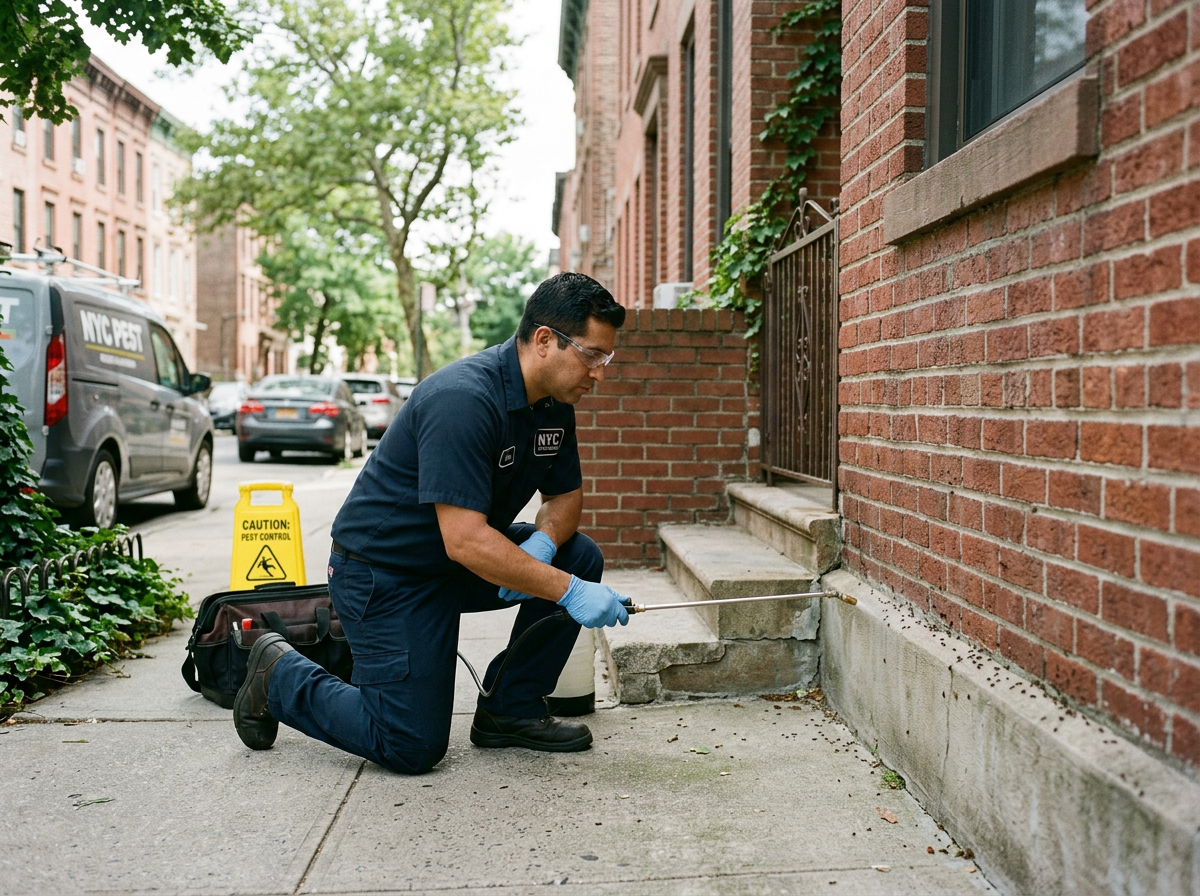
In Thiells and surrounding Hudson Valley towns, pavement ants and odorous house ants commonly follow expansion joints in rubble foundations and cracked clay sewer laterals. These colonies often nest several feet back from visible entry points, using the same fieldstone gaps that allow rodents inside. Treating only the foraging line leaves satellite nests untouched, so activity resumes within days once the initial scouts are gone.
Carpenter ants appear in homes with older timber sills and soffit voids where roofline moisture has softened the wood. Workers travel along shared party walls in downstate stock or through attic insulation upstate, dropping frass near baseboards. Liquid bait placed along these routes reaches the parent colony only when stations are set at both ground level and upper voids; otherwise the queen remains unaffected.
Ant Control Near You — Choose Your City
Every city below has its own local Ant Control page with coverage details.
Nassau
Suffolk County
Rensselaer
Dutchess County
Monroe County
Ulster
Westchester
Suffolk
Erie County
Ontario County
Erie
Nassau County
Ulster County
Dutchess
Niagara
Saratoga
Orange
Cayuga
Wyoming
Columbia County
Allegany County
Sullivan County
Queens County
Albany County
Wayne
Rockland County
Onondaga
Rockland
Warren County
Autumn cooling drives ants indoors toward heated slabs and boiler rooms, concentrating trails along expansion joints and around utility penetrations. Missed gaps behind kitchen cabinets or in garage thresholds allow re-entry the following season. Thorough work requires mapping the full route from exterior soil line to interior harborage before any product is applied.
Success depends on access to wall voids and sub-slab areas that most homeowners cannot reach without removing trim or drilling. Without that access, visible ants decrease temporarily but the colony simply shifts to the next available crack.
Technician insight
In Thiells, the thing that catches most people out with Ant Control is the old fieldstone foundations that let pavement ants nest three or four feet back from the visible crack; homeowners spray the line they see and the colony simply moves to the next joint in the rubble.
Thiells Split-Level Kitchen Trails
Homeowner reported persistent ants along baseboards after heavy rain. Inspection found trails entering through a cracked clay sewer lateral penetration and traveling up the wall void behind the sink. Bait stations were placed at the exterior soil line and inside the void after removing the toe-kick; the colony declined within ten days and no new activity appeared the following season.
Ant Control Services We Offer
✓Pavement Ant Trail Treatment
Locates and treats active pavement ant colonies along foundation cracks and expansion joints common in Thiells rubble foundations.
✓Carpenter Ant Void Inspection
Inspects timber sills, soffits and wall voids for carpenter ant galleries in older New York homes before bait placement.
✓Odorous House Ant Bait Program
Sets targeted bait stations along interior and exterior trails to reach satellite nests that form in Hudson Valley crawlspaces.
✓Kitchen and Cabinet Ant Exclusion
Seals gaps behind appliances and cabinetry where ants enter from wall voids in older Thiells kitchens.
✓Exterior Perimeter Ant Barrier
Applies residual material and monitors stations around the soil line to interrupt seasonal migration into heated structures.
How it works
- 1
Initial Inspection
Technician maps active trails from exterior soil line through foundation gaps into interior voids and moisture areas.
- 2
Nest Location
Uses access points in wall voids or sub-slab areas to identify primary and satellite colony sites.
- 3
Bait Placement
Positions liquid and gel baits along travel routes so workers carry material back to the queen.
- 4
Entry Point Sealing
Closes accessible gaps at utility penetrations and foundation cracks to prevent re-infestation.
- 5
Follow-Up Check
Returns to verify colony decline and adjust stations if activity persists.
Pricing
Scope depends on building age, number of active trails, and whether wall or sub-slab access is required; call for an inspection-based quote.